


BIM: Technology that opens a new era in construction
Today, when asked "Do you work in BIM?" you can hear "Of course, we've been in BIM for more than a year, we all work in Revit / Archicad / Tekla". But is this really the case? Does the use of specialized applications mean belonging to BIM? There is no denying that the listed software is BIM-oriented. But their use alone does not guarantee that your company has begun to work in BIM, just as if you put on a hockey sweater does not mean that you are a hockey player. So why do companies try their best to show themselves to be BIM-capable? Let's find out.
Is BIM profitable?
Whether we like it or not, the term "BIM" is increasingly being used in our vocabulary, especially in its direct field of application, "design and construction". A lot of myths, misconceptions and fantasies revolve around it (BIM). Why is this happening?
The volume of the Building Information Modeling (BIM) market in 2016 amounted to about 3.52 billion USD and, according to Zion Market Research, will grow almost 3 times to 10.36 billion USD by 2020.

https://www.zionmarketresearch.com/
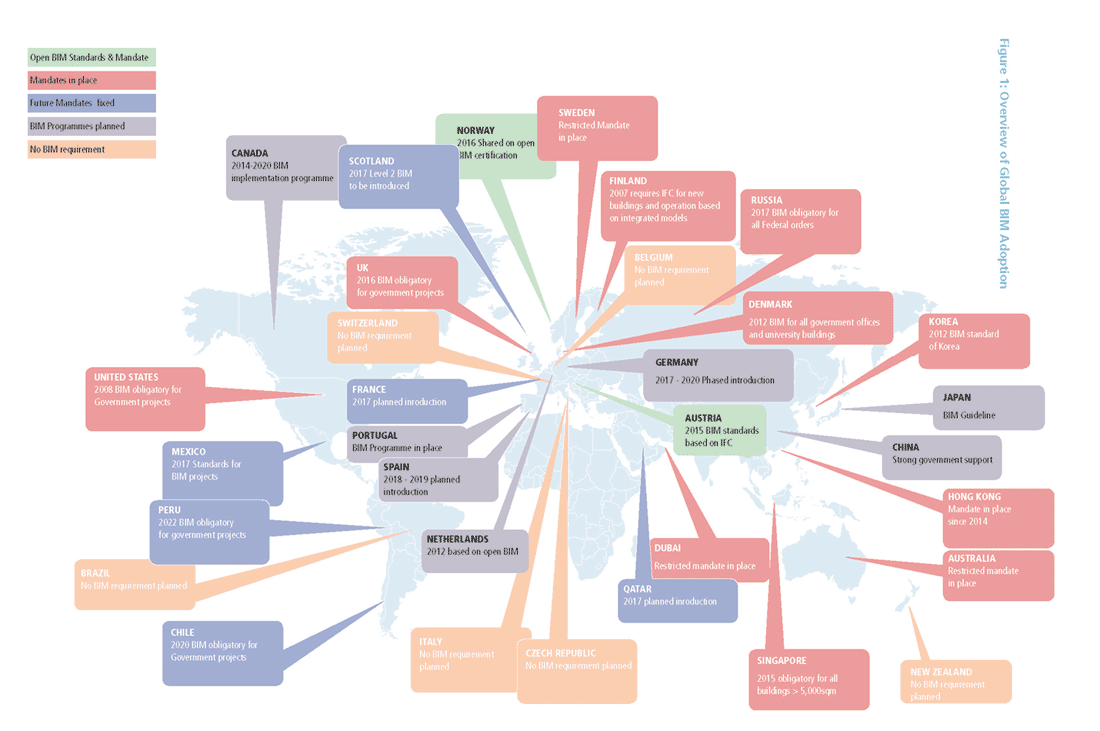
BIM leaders are advanced countries such as the UK, USA, Singapore, Australia. These countries were the first to benefit from the introduction of BIM and continue to increase their pace. More conservative European countries, such as Spain, France, Germany, Poland, and, not surprisingly, Belarus, are trying to keep up with them.
BIM adds weight to the company, it adds innovation, it gives it a boost over competitors. It is believed that with the help of BIM it is possible to do things faster and better (this is true, in fact), and cheaper (and this is not always the case), and this bribes the client, and if clients are not prepared, they may buy into BIM. It sounds the same, but the quality is completely different.
Where do BIM skeptics come from?
There are many skeptics about BIM. Where do they come from? Skepticism is not really a bad thing. But like any popular movement, there are antagonists. And so does BIM have haters or BIM skeptics. Usually, these are the same people who do not use layers and layout in autocad as intended. These are the ones who in the 2010s say, "Oh, come on, your Revit, I'm faster in the line," and in the 90s they said, "Oh, come on, your autoCAD, I'll draw faster with a pencil. In general, there are those who are not in a hurry to understand what BIM is - it's too complicated.
"Why is 3D not BIM?"
There is another category of BIMers who think it's simple: if I draw in 3D, I work in BIM. Of course, this is a mistake. To understand this, it is enough to recall that 3D has existed for a long time - and then no one called the model BIM. Why? For comparison, let's take a 3D max and Revit wall model. Why is 3D max not BIM, but Revit can become BIM?
The key difference is in the data. Many people forget (or don't realize) that BIM is an information model of a building. Translated from English, it means "building information model". In other words, it is the information that forms the building data model. Thus, 3D display is one of many slices in the information model about a particular building. This is the key difference between BIM-oriented software and geometry modeling programs. Returning to the wall model in 3D-max, a wall is a kind of visual representation of an object and this object is a wall only in our abstract representation. While in Revit the wall is a part of the building, and in the model the object is defined as a wall. This information is stored and transferred to other BIM software, which also defines the object as a wall. In addition to this, other data is assigned to the object, such as belonging to a level, material of manufacture, date of construction or dismantling, composition, cost, etc.
Thus, comprehensive data about an object is a key element in the formation of BIM, and 3D display is just one way to represent this data.
What is BIM?
I wrote above that BIM is profitable! But why? Why is so much effort, billions of dollars invested, and where does the effect of using BIM come from?

We all feel for ourselves how the IT industry is progressing every year - it is the most indicative sector of the economy. It is here that the largest number of innovations are applied. Construction is the most backward sector and the most conservative. But the latest super modern buildings simply cannot be built without an innovative approach. It's not just about complex shapes. Modern buildings are a bundle of technologies and engineering systems. Modern buildings have high requirements for comfort, functionality, and economic efficiency. Without interdisciplinary coordination, construction would be delayed for many years, but with the use of BIM, builders have the opportunity to obtain data that will allow them to simulate construction and obtain other data that, in turn, will reduce construction time. The information model makes it possible to conduct a stress analysis of engineering systems in a virtual environment, identify the weaknesses of the construction object and the ability to eliminate them, and thus obtain an economic effect.

Today, BIM is not just a model. In modern construction, the term BIM implies a methodology using best practices for the entire life cycle of a building, from concept to operation and disposal. BIM today is a complex technological business process that involves systematic data creation and management.
In the near future, BIM will become a standard methodology for every professional construction and design company, and BIM standards from different countries will be combined into one international ISO BIM standard.